Original Japanese WWII Late War Enlisted Mans Wool Tunic – 2nd Class Private
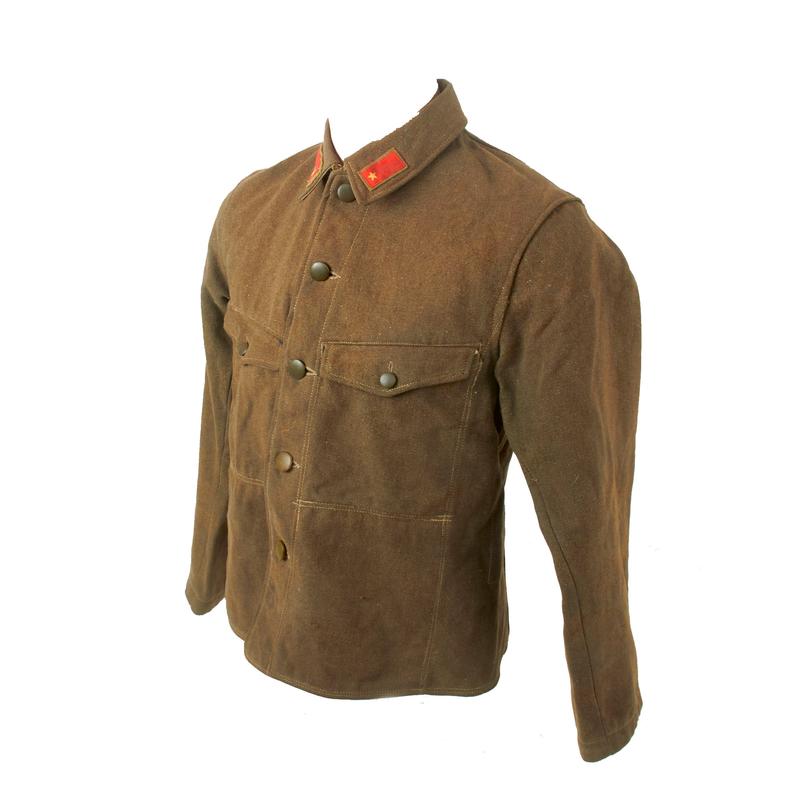
Original Japanese WWII Late War Enlisted Mans Wool Tunic – 2nd Class Private
 (0 reviews)
Original Item. Only One Available. This is a very been-there example of a Second World War Japanese wool Enlisted Mans tunic, with 2nd Class Private ranks sewn onto the collars.This is a rare original Japanese wool enlisted mans tunic with...
Quantity:
Categories :
Original Item. Only One Available. This is a very been-there example of a Second World War Japanese wool Enlisted Mans tunic, with 2nd Class Private ranks sewn onto the collars.
This is a rare original Japanese wool enlisted mans tunic with the rank for 2nd Class Private stitched on both collars. The uniform only has a top set of pockets, and has all its buttons retained. There is no tag on the interior but some very faint depot stamps can be found. There is damage in several spots across the uniform, including some fraying on both cuffs and a small rip in the lower back. The original hanging loop is still retained.
The Imperial Japanese Army was the official ground-based armed force of the Empire of Japan from 1868 to 1945. It was controlled by the Imperial Japanese Army General Staff Office and the Ministry of the Army, both of which were nominally subordinate to the Emperor of Japan as supreme commander of the army and the Imperial Japanese Navy. Later an Inspectorate General of Aviation became the third agency with oversight of the army.
During wartime or national emergencies, the nominal command functions of the emperor would be centralized in an Imperial General Headquarters (IGHQ), an ad hoc body consisting of the chief and vice chief of the Army General Staff, the Minister of the Army, the chief and vice chief of the Naval General Staff, the Inspector General of Aviation, and the Inspector General of Military Training.
In 1941, the Imperial Japanese Army had 51 divisions and various special-purpose artillery, cavalry, anti-aircraft, and armored units with a total of 1,700,000 people. At the beginning of the Second World War, most of the Japanese Army (27 divisions) was stationed in China. A further 13 divisions defended the Mongolian border, due to concerns about a possible attack by the Soviet Union. From 1942, soldiers were sent to Hong Kong (23rd Army), the Philippines (14th Army), Thailand (15th Army), Burma (15th Army), Dutch East Indies (16th Army), and Malaya (25th Army). By 1945, there were 6 million soldiers in the Imperial Japanese Army.
From 1943, Japanese troops suffered from a shortage of supplies, especially food, medicine, munitions, and armaments, largely due to submarine interdiction of supplies, and losses to Japanese shipping, which was worsened by a longstanding rivalry with the Imperial Japanese Navy. The lack of supplies caused large numbers of fighter aircraft to become unserviceable for lack of spare parts, and \”as many as two-thirds of Japan\’s total military deaths [to result] from illness or starvation\”.
There are no reviews yet.
Related Products

Original German WWII Heer Army Artillery 1935 Pattern...
Original German WWII Black 3rd Class Wound Badge...
Original German Pre WWII 1936 Summer Olympics Volume...
