Original U.S. WWI Identified 42nd Division Uniform and Dog Tags – 166th Infantry Regiment
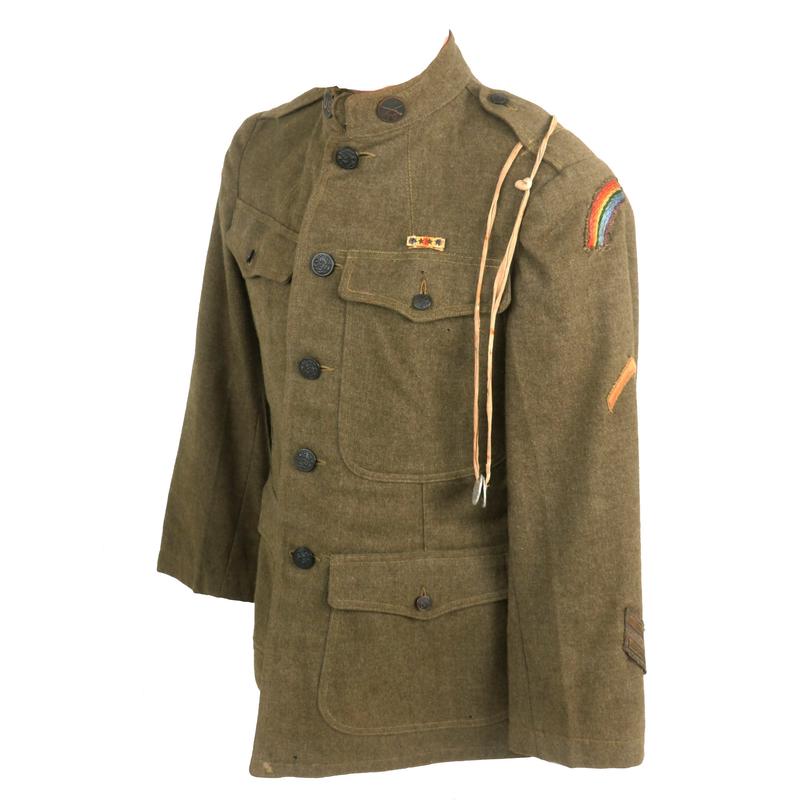
Original U.S. WWI Identified 42nd Division Uniform and Dog Tags – 166th Infantry Regiment
 (0 reviews)
Original Item. One-of-a-Kind. This is a stellar 42nd Division uniform with a gorgeous hand-stitched rainbow patch, and a set of dog tags fully identifying the soldier as Samuel M. Wood, Headquarters Company, 166th Infantry Regiment.Samuel Mathus Wood was born on...
Quantity:
Categories :
Original Item. One-of-a-Kind. This is a stellar 42nd Division uniform with a gorgeous hand-stitched rainbow patch, and a set of dog tags fully identifying the soldier as Samuel M. Wood, Headquarters Company, 166th Infantry Regiment.
Samuel Mathus Wood was born on February 22nd, 1890 in Bath, Virginia. At a young age his family moved to Goshen, Virginia, where hed live for most of his life. Wood was inducted into the National Army on September 5th, 1917, being taken overseas and assigned as a replacement to the Headquarters Company, 166th Infantry Regiment, 42nd Division. While attached to the 166th, Wood saw combat in the Aisne-Marne, St. Mihiel, and Meuse-Argonne Offensives, as well a defensive sector. Wood returned stateside with the division on April 18th, 1919, being discharged days later. Wood returned home to his life of farming in Goshen, where he spent the rest of his life. Wood passed away on May 13th, 1979, having worked as a farmer all his life.
Woods uniform has a phenomenal hand-stitched 42nd division insignia, discharge chevron, and two overseas chevrons on the left sleeve. He has US & Infantry HQ Company collar discs. Woods uniform has a Victory ribbon with 4 campaign stars above the left breast pocket, most certainly for the Aisne-Marne Offensive (July 25 – Aug. 6th, 1918), the St. Mihiel Offensive (Sept. 12-16th, 1918), the Meuse-Argonne Offensive (Oct. 5th – Nov. 10th, 1918), and the Essey-Pannes Defensive Sector (Sept. 17th – Oct. 1st, 1918). The ribbon has heavy fraying as shown. Woods dog tags are tied around his left shoulder board, which is where they were when we received it. Both tags are full of info reading SAMUEL WOOD, PVT. HQ CO 166 INF 172935. His transport log incorrectly lists his serial number as 172915, which is a common mistake.
This is a very difficult unit to find any pieces from, given their extensive combat record and their desire by collectors. Dont miss out!
The 42nd Division
When the United States declared war on Germany in April 1917, and so officially entering World War I, it federalized the National Guard and formed their units into divisions to quickly build up an Army. In addition, Douglas MacArthur, then a major, suggested to William Abram Mann, the head of the Militia Bureau, that he form another division from the units of several states that were not assigned to divisions. Secretary of War Newton D. Baker approved the proposal, and recalled MacArthur saying that such an organization would \”stretch over the whole country like a rainbow.\” On 1 August 1917, the War Department directed the formation of a composite National Guard division, comprising units from 26 states and the District of Columbia. As a result, the 42nd Division came to be known as the \”Rainbow Division\”. The name stuck, and MacArthur was promoted to colonel and became the division\’s chief of staff, with Mann as its commander.
The 42nd Division was assembled in August 1917 at Camp Mills, New York, four months after the American entry into World War I. The 42nd arrived overseas to the Western Front of Belgium and France in November 1917, one of the first divisions of the American Expeditionary Forces (AEF) to do so, under the command of Major General William A. Mann although he was soon to be replaced by Major General Charles T. Menoher, who remained in this position for the rest of the war. Colonel Douglas MacArthur was the division\’s chief of staff until he later went on to command the 84th Brigade of the division. The AEF was commanded by General John Joseph Pershing. After initially landing at St. Nazaire (France), the 42nd was temporarily located at Vaucouleurs, Lorraine (France), from 7 November 7 December 1917, to preliminarily train before transferring to another training area between Lafauche and Rimaucourt. The day after Christmas, the 42nd, along with other divisions it had now linked up with, departed for another training area near Rolampont, Langres (France). French officers had been attached to the 42nd at Lafauche, Rimaucourt, and Rolampont as instructors in trench warfare who \”…seemed, from Menoher and MacArthur\’s view, to think more highly of the Rainbow\’s performance than did Pershing and his Chaumont staff\”.
There are no reviews yet.
Related Products
Original U.S. Civil War Confederate Georgia Joe Brown...
Original German WWII Rare Pioneer Mine Tool Case...

Original German WWII Balkenkreuz (Beam Cross) Panzer Tank...